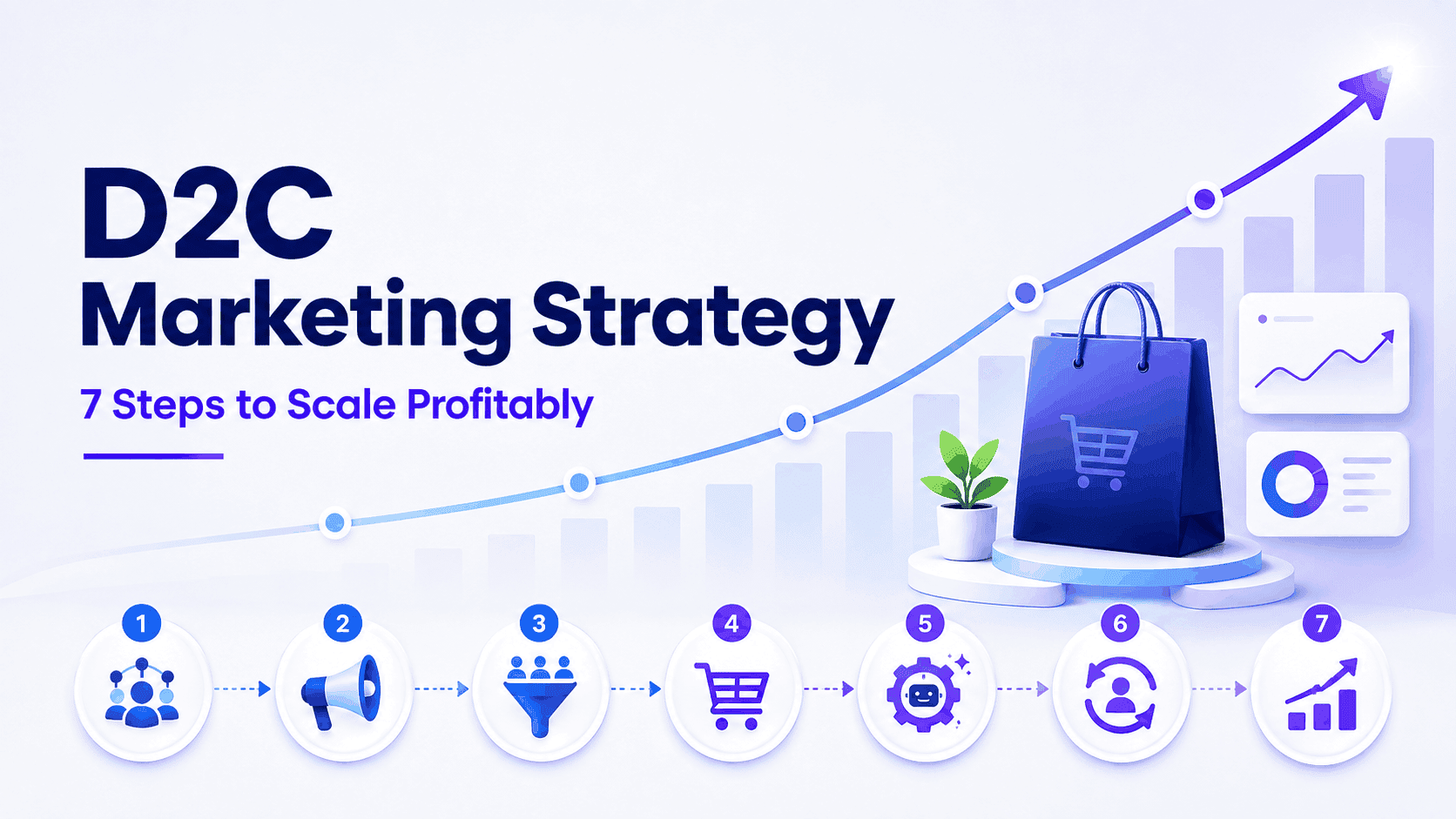
D2C Marketing Strategy in 2026: 7 Steps to Scale Profitably
A successful D2C marketing strategy is not a collection of disconnected ads, posts and tools. It is a connected growth system that helps a brand understand its audience, communicate a clear offer, acquire customers efficiently, improve conversion rates and build repeat revenue.
For most D2C and eCommerce brands, profitable growth comes from aligning five areas: customer research, content and creative, paid acquisition, website conversion, and retention. The seven-step framework below brings these areas together so every campaign supports the same business goal.
Key Takeaways
- Start with customer insight and unit economics before increasing ad spend.
- Build one clear offer and message for each audience segment.
- Treat content, ads, landing pages and email as one connected funnel.
- Track meaningful business outcomes, not only reach, clicks or followers.
- Use AI to improve research and execution speed while keeping strategy and brand direction human-led.
- Scale only the campaigns, products and audiences that demonstrate repeatable profitability.
What Is a D2C Marketing Strategy?
A D2C marketing strategy is a plan for attracting, converting and retaining customers without depending entirely on traditional distributors or marketplaces.
It defines who the brand wants to reach, what value it offers, which channels it will use, how the customer journey will work and which metrics will determine success.
A complete D2C strategy normally includes:
- Audience and competitor research
- Brand positioning and offer development
- Organic content and paid advertising
- Product pages and conversion-focused landing pages
- Email, WhatsApp or customer relationship automation
- Analytics, attribution and campaign reporting
- Retention, repeat-purchase and referral systems
The objective is not simply to generate more traffic. The objective is to turn the right traffic into profitable customers and long-term brand value.
Why D2C Brands Struggle to Scale
Many D2C brands do not have a traffic problem. They have a connection problem.
The social media team creates content, the media buyer runs ads, the website team updates pages and the founders review sales reports—but each activity happens separately.
This creates inconsistent messaging, weak landing-page experiences, incomplete tracking and slow decision-making.
A connected marketing system gives every activity a defined role:
- Content creates awareness and demand.
- Ads distribute winning messages to relevant audiences.
- Landing pages convert interest into action.
- Automation follows up with prospects and customers.
- Analytics shows what should be improved or scaled.
At 7Art, we use a seven-stage growth loop to connect these activities into one practical D2C growth strategy.
Step 1: Discover the Brand, Customer and Growth Goal
Before selecting channels or creating campaigns, define the business problem clearly.
Start by answering five questions:
- Who is the highest-value customer?
- What problem does the product solve?
- Why should someone choose this brand instead of an alternative?
- Which product has the strongest margin and repeat-purchase potential?
- What is the primary growth goal for the next 90 days?
The goal may be to increase first-time purchases, improve return on ad spend, launch a new product, reduce customer acquisition cost or grow repeat revenue. Each goal requires a different strategy.
Customer research should combine quantitative and qualitative information. Review analytics, product-level sales, search terms, customer reviews, support conversations, social comments and competitor messaging.
Speak directly with customers whenever possible. The language customers use to describe their problems often becomes the strongest source of ad hooks, landing-page copy and content ideas.
Output of this stage: A clear audience profile, growth objective, core customer problem and differentiated value proposition.
Step 2: Analyze the Existing Funnel
The next step is to identify where revenue is being lost.
Map the complete customer journey:
Ad or content → landing page or product page → cart → checkout → purchase → repeat purchase
Review performance at each stage by asking:
- Are campaigns attracting the right audience?
- Do the ads and landing pages communicate the same promise?
- Is the product value clear within the first screen?
- Are shipping, return and delivery details easy to find?
- Is the mobile experience fast and simple?
- Is conversion tracking configured correctly?
- Are abandoned carts and previous customers being followed up?
Google recommends implementing reliable website conversion measurement so campaign decisions are based on actual customer actions. Its official guide explains how Google Ads tracks website conversions.
Do not optimize only for the cheapest click. A low-cost campaign that attracts low-intent visitors can be less valuable than a more expensive campaign that produces qualified customers and repeat purchases.
Output of this stage: A prioritized list of funnel gaps, measurement issues and conversion opportunities.
Step 3: Architect the Growth Roadmap
Once the audience and funnel are understood, build a focused 90-day roadmap.
The roadmap should define:
- Priority products or services
- Core customer segments
- Primary offer and promotional logic
- Main acquisition channels
- Content themes and creative angles
- Landing pages and conversion assets
- Retargeting and follow-up journeys
- Weekly and monthly performance metrics
Avoid trying to scale every product on every channel at the same time. Select one or two priority offers, prove the message and funnel, and then expand.
A useful campaign structure connects different levels of customer intent.
Awareness
Educational content, founder stories, problem-led videos and category insights introduce the brand to people who may not know they need the product yet.
Consideration
Comparisons, demonstrations, reviews, use cases, testimonials and FAQs help prospects evaluate the product.
Conversion
Offer-led ads, product pages, landing pages, retargeting and abandoned-cart communication reduce hesitation and encourage action.
Retention
Post-purchase education, replenishment reminders, cross-sells, loyalty benefits and referral campaigns increase customer value.
Output of this stage: A channel-by-channel plan with ownership, timelines, required assets and measurable outcomes.
Step 4: Create a Content and Creative System
D2C growth depends heavily on the quality and consistency of creative testing.
Instead of producing random posts, build a repeatable content system around customer intent.
A strong system may include:
- Problem–solution videos
- Product demonstrations
- Founder-led content
- Customer testimonials and user-generated content
- Before-and-after stories
- Objection-handling posts
- Product comparisons
- Educational carousels
- Offer-focused advertisements
- Email and WhatsApp sequences
Each creative should test a specific variable: hook, audience problem, product benefit, proof, format, offer or call to action. This makes results easier to interpret.
For organic search, focus on original and useful information rather than publishing generic articles only to target keywords.
Google’s people-first content guidance recommends creating content for an intended audience, demonstrating genuine experience and giving readers enough information to achieve their goal.
AI can support research, idea generation, content repurposing and testing speed. However, raw AI output often sounds generic.
Human review is still required to add brand voice, real experience, accurate claims, original examples and a clear point of view.
Output of this stage: A monthly content calendar, creative testing matrix and library of reusable brand assets.
Step 5: Activate Paid, Organic and Retention Channels
Activation means launching the connected system—not simply turning on advertising campaigns.
A balanced D2C channel mix may include:
- Meta Ads for demand generation, visual storytelling and retargeting
- Google Ads for high-intent search and shopping demand
- Search engine optimization for long-term discovery
- Social media for education, trust and community
- Email and WhatsApp for follow-up, retention and repeat purchases
- Influencer or creator partnerships for reach and social proof
Channel selection should depend on customer behavior, product economics and available creative resources.
A visually demonstrable product may perform well through short-form video. A high-consideration product may require search content, comparison pages, demonstrations and stronger email nurturing.
Keep the message consistent across the journey. A customer who clicks an advertisement about a specific problem should reach a page that continues the same story, presents relevant proof and offers one clear next step.
Output of this stage: Live campaigns, connected landing pages, retargeting audiences and automated follow-up journeys.
Step 6: Optimize Conversion and Measurement
More traffic does not automatically create more revenue. Conversion rate optimization helps a brand generate more value from the visitors it already has.
Review the following areas:
- Mobile page speed and usability
- Headline and value proposition clarity
- Product imagery and demonstrations
- Reviews, guarantees and trust signals
- Pricing, shipping and return transparency
- Form and checkout friction
- Calls to action
- Frequently asked questions
- Cart abandonment and follow-up timing
Shopify defines eCommerce conversion rate as the percentage of online-store visits that result in an order.
Its guide to eCommerce conversion rate optimization recommends evaluating traffic quality, device mix, checkout friction, value clarity and trust signals when improving an online store.
Run tests based on evidence. Start with high-impact pages and significant friction points rather than changing multiple elements without a clear hypothesis.
A simple measurement dashboard can track:
Output of this stage: Cleaner data, stronger conversion rates and a documented testing process.
Step 7: Scale What Is Repeatable and Profitable
Scaling should happen only after the brand has evidence that its marketing system works.
A campaign is not ready to scale simply because it generated a few low-cost purchases. Check whether performance remains stable across time, audience expansion, creative fatigue and higher budgets.
Profitable scaling can involve:
- Increasing spend gradually on proven campaigns
- Creating variations of winning creative concepts
- Expanding into adjacent audiences or locations
- Improving average order value through bundles and cross-sells
- Strengthening retention and replenishment journeys
- Building SEO content around demonstrated customer demand
- Automating reporting and routine workflows
- Launching new products to existing high-value customers
The objective is to create a growth engine that becomes more efficient as the brand learns—not a cycle of constantly replacing failed campaigns.
Explore examples of website, organic, social and paid growth outcomes on the 7Art results page.
How AI Fits into a Modern D2C Marketing Strategy
AI is most useful when it improves the speed and quality of specific marketing tasks.
Practical applications include:
- Summarizing customer reviews and support conversations
- Identifying recurring objections and content themes
- Creating first-draft advertisement variations
- Repurposing long-form content into shorter formats
- Organizing campaign reports
- Detecting performance patterns
- Drafting workflow and automation logic
- Supporting keyword and competitor research
AI should not replace customer understanding, strategic judgment or original brand thinking.
Google’s guidance for generative AI search optimization emphasizes useful original content, a clear technical structure, accurate business information, strong internal linking and standard SEO foundations.
Create content that offers something specific: first-hand experience, original frameworks, unique data, expert commentary, client learnings or a practical process readers can use.
This makes the content more valuable to human readers and easier for search and AI systems to understand, extract and reference.
Choosing a D2C Marketing Agency in Noida or Delhi NCR
For brands based in Noida, Delhi, Gurugram or the wider Delhi NCR region, working with a local growth partner can make strategy workshops, content production and regular collaboration easier.
Location alone, however, should not be the deciding factor.
Evaluate a D2C agency on:
- Understanding of D2C unit economics
- Ability to connect creative, ads, websites and retention
- Quality of tracking and reporting
- Clarity of its testing methodology
- Experience with eCommerce platforms
- Capacity to protect the brand while improving performance
- Willingness to connect marketing activity with business outcomes
7Art is a D2C growth and performance marketing agency based in Noida, Delhi NCR.
We help D2C brands, eCommerce businesses and startups connect strategy, creative content, paid acquisition, conversion-focused funnels, automation and analytics.
About 7Art
7Art is an AI-assisted D2C growth and performance marketing agency based in Noida, Delhi NCR. The agency helps D2C brands, eCommerce businesses and startups grow through strategy, creative content, performance marketing, conversion-focused funnels, automation and analytics.